Why Your Nordic Poles Slip on Wet Leaves and How to Fix It in 30 Seconds
Quick Answer: Poles slip on wet leaves because a leaf layer acts like a lubricated sheet over pavement — your tip plants on the leaf, not the ground. Fix it by removing the rubber paws so the carbide tip can punch through, and by planting 5-10 degrees more vertical than usual so the force goes down instead of backward.
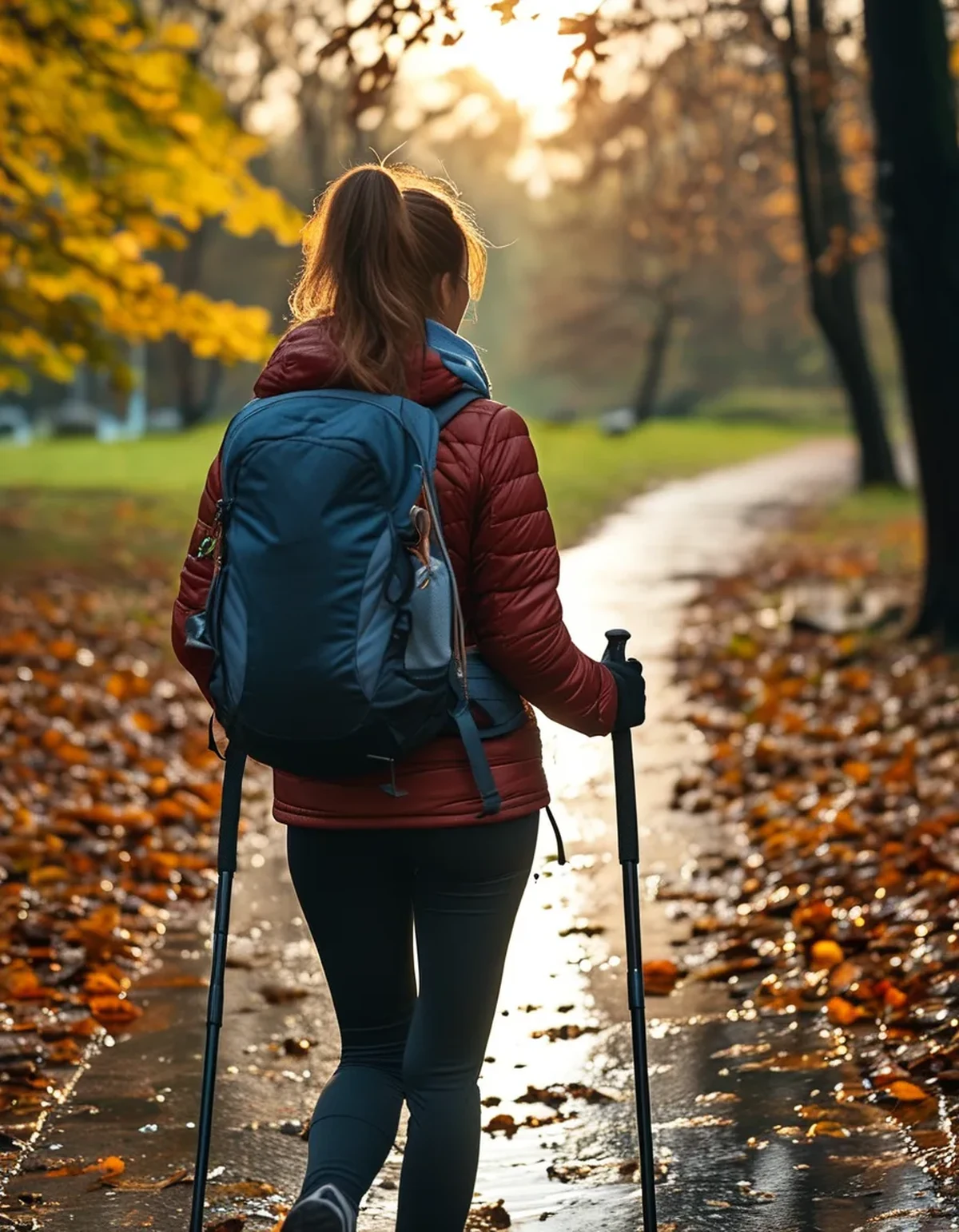
The first properly wet week of the season is when it happens. You plant, you push, and the pole skates six inches backward with nothing to grab.
It is startling, it wrecks your rhythm, and on a downhill it is genuinely how people fall. The frustrating part is that nothing about your technique changed — the ground did.
Here is what is actually going on underfoot, and the two adjustments that fix it.

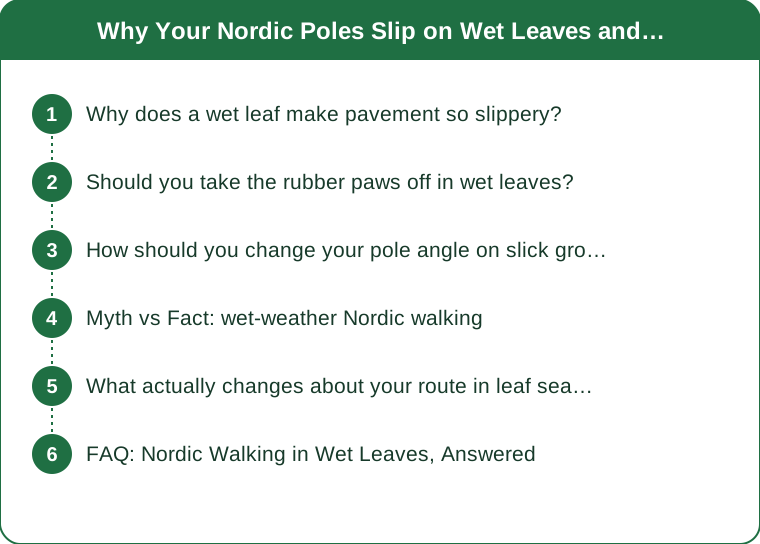
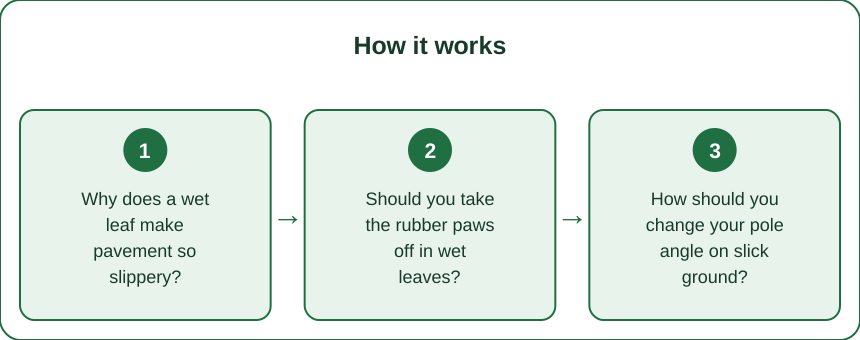
Why does a wet leaf make pavement so slippery?
A single dry leaf is nothing. A wet leaf layer is a different surface entirely.
When leaves get soaked, they flatten and press into a thin, continuous mat. Water sits between the leaf and the pavement, and between the leaf and your pole tip. You now have two slick interfaces stacked on top of each other, and your carbide tip is landing on the top one — the leaf — rather than biting the ground.
Worse, decomposing leaves release tannins and a slimy pectin residue that behaves like a lubricant. This is the same reason train companies genuinely delay service over “leaves on the line.”
The practical takeaway: your tip is not dull and your technique is not broken. The tip simply never reaches anything solid.
A useful test — drag your pole tip across a dry patch of the same path. If it catches and screeches, your carbide is fine, and the leaves are the whole story.
Should you take the rubber paws off in wet leaves?
Yes, in almost every case — and this is the single fastest fix.
The rubber paws (the angled boots most poles ship with) are designed to give a broad, grippy footprint on hard pavement. On a leaf mat, a broad footprint is exactly wrong. It spreads your force over the slick leaf surface instead of concentrating it.
Pull the paws off and the bare carbide tip becomes a small, hard point that punches through the leaf layer and reaches the asphalt underneath. It takes about 30 seconds for both poles.
A few honest caveats:
- Bare tips are noisy and they scratch. On a paved path nobody cares. Around a boardwalk or a neighbor’s driveway, expect clicking.
- Carry the paws in a pocket, not in the car. You will want them back the moment you leave the leaves.
- On a thick, deep leaf pile — ankle-deep drifts rather than a flat mat — nothing punches through. Walk that section without pushing hard through the poles.
This one change solves maybe 70% of late-season slipping.
How should you change your pole angle on slick ground?
Nordic walking works because you plant the pole behind your body at roughly 60 degrees and push backward. That backward push is exactly the force that skates on a slick surface.
Plant 5-10 degrees closer to vertical than your normal angle. You lose a small amount of propulsion and you gain a tip that stays where you put it, because more of the force is directed straight down into the ground rather than along it.
Two more adjustments that pair with it:
- Shorten your stride slightly. A long stride forces a shallow pole angle. Take the stride back by about 10% and the angle corrects itself.
- Push through the strap more gently on the plant, then build. A hard initial push is what breaks traction. A soft plant followed by a firm push gives the tip a moment to settle in.
Think of it as the pole equivalent of driving on ice: smooth inputs, no sudden loads.
Myth vs Fact: wet-weather Nordic walking
Myth: Dull tips are why poles slip in autumn. Fact: Carbide tips last hundreds of miles. If slipping started the same week the leaves fell, the surface changed, not your tips. Check the drag test above before you buy replacements.
Myth: Rubber paws grip better in the wet. Fact: They grip better on clean wet pavement, and worse on anything with a layer over it — leaves, loose grit, wet moss. Match the tip to what is on the ground, not to the weather.
Myth: You should shorten your poles for slippery conditions. Fact: Pole length is set by your height and stays there. What changes is plant angle and stride. Shortening poles just gives you a hunched posture and a weaker push.
Myth: The danger is on the flats. Fact: The falls happen going downhill, where you instinctively reach further forward and lean on the pole for braking. That is the shallowest, most slip-prone plant angle you ever use.
What actually changes about your route in leaf season?
A route you have walked all summer is a different route in October, and it is worth planning for.
The worst spots are predictable. Under mature trees, on the downwind side of a building, in the low corner of a path where water pools, and anywhere a curb collects drifts. Those are the four places to ease off.
Painted surfaces double the problem. Crosswalk stripes and painted bike lanes are already slick when wet; add a leaf layer and there is nothing for a tip to find. Cross them with poles carried short rather than planted hard.
Grass beside the path is often the better option. Damp turf takes a bare carbide tip beautifully. If a paved stretch is buried in leaves, step onto the verge for 50 yards.
Go earlier or later than the rain. Leaves are at their slickest in the hours right after rain stops, before wind and traffic clear them. A morning walk on a path that got rained on overnight is the classic setup.
FAQ: Nordic Walking in Wet Leaves, Answered
Are bare carbide tips safe on wet pavement without leaves?
Yes. Carbide bites into concrete and asphalt just fine, wet or dry — that is what it is designed for. The downside is noise and a slightly harsher feel through the wrist, which is why paws exist. On a clean wet path, either works; in leaves, bare tips win clearly.
Do I need special poles for autumn conditions?
No. The same poles work all year — this is a tip-and-technique problem, not an equipment problem. If you are buying anyway, look for poles where the paws twist off easily by hand rather than needing a tug, because you will be swapping them a lot from October through December.
What if I slip anyway — how do I fall safely with straps on?
This is the real argument for well-fitted straps: a proper Nordic strap lets your hand release the grip while staying connected, so you can put a hand out. If your straps are cinched so tight that your hand cannot open, loosen them one notch. You should be able to open your palm completely and still have the pole hang from your wrist.
TL;DR:
- Wet leaves create two slick layers between your tip and the ground — your carbide never reaches anything solid.
- Take the rubber paws off. It takes 30 seconds and fixes most of the slipping.
- Plant 5-10 degrees more vertical and shorten your stride about 10% so force goes down, not backward.
- Expect the worst grip under mature trees, on painted lines, and in the hours right after rain stops.
None of this needs new gear or a new technique — it needs you to notice that the ground changed and to adjust for a few weeks. Once the leaves are down and cleared, put the paws back on and go back to your normal plant angle. The walkers who quit in November usually quit because one bad skate scared them, and that skate was entirely preventable.
See It in Motion
Seen here: High Waist Yoga Leggings with Side Pockets — shop it on bubblelime.com
Keep Reading
This article is for general informational and styling purposes only. Fit, sizing, and product availability may vary.