Why Does Downhill Nordic Walking Need a Different Pole Action?
Quick Answer: On the flat and uphill, the pole plants beside or behind you and you push backward to propel yourself. Descending, the pole has to plant ahead of your foot so it can absorb load instead of adding it — a different plant position, a different angle, and a longer pole. Most people never change any of the three.
You have the flat technique. You have the climbing technique.
Nobody teaches the third one, and it is the one that protects your knees.
This is general information, not medical advice.
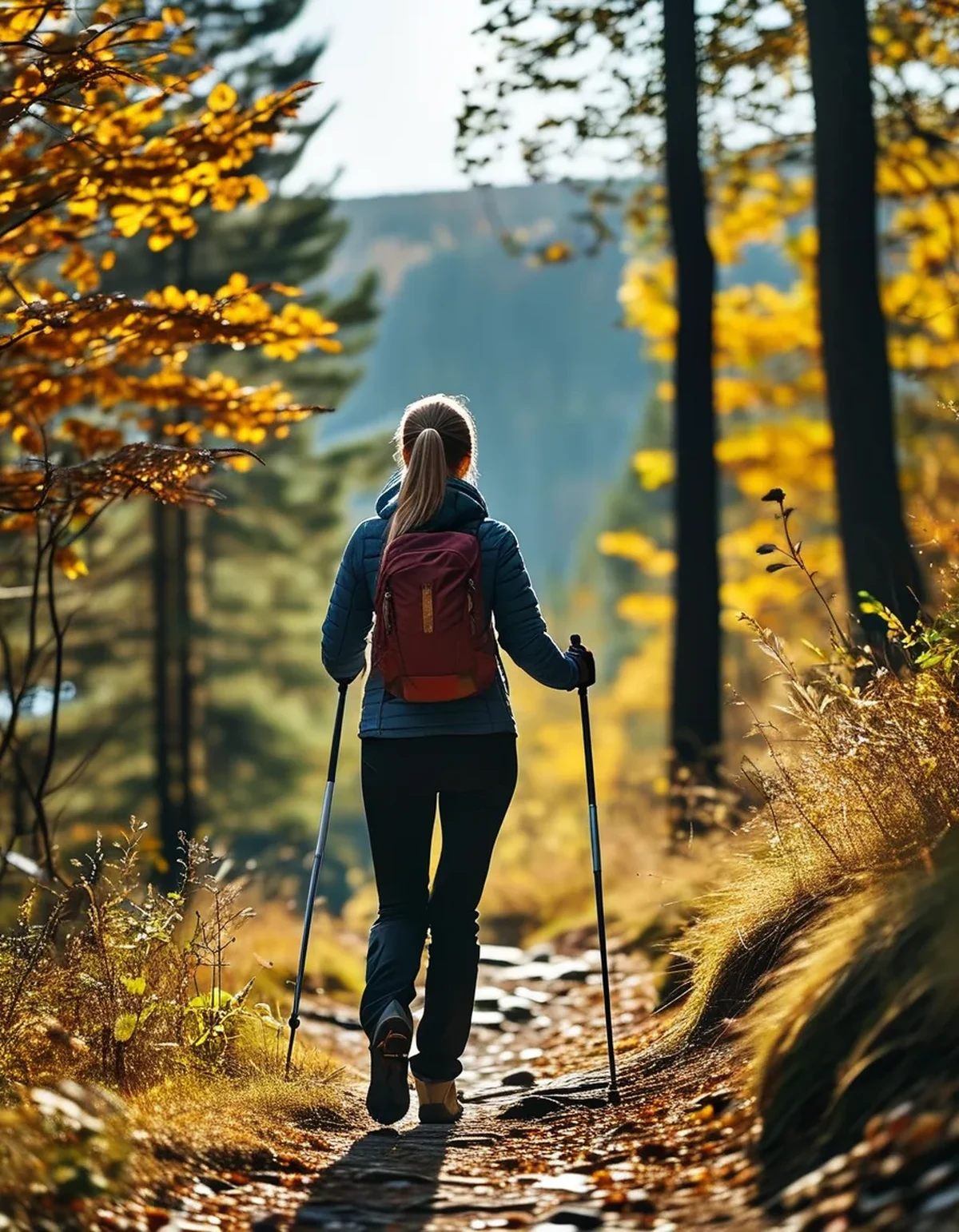
What is the pole doing differently on a descent?
Reversing its job.
On flat ground and uphill, nordic walking is propulsive. The pole plants at an angle behind vertical, you press through the strap, and the push adds forward drive. The upper body is contributing power.
Going downhill, gravity is already supplying more forward drive than you want. The pole’s job becomes braking and load-sharing — taking some of the impact that would otherwise go entirely through your knee on each step down.
That requires the pole to be ahead of you, not behind. A pole planted behind on a descent does nothing useful; it is pushing you further down a slope you are already descending too fast on. Worse, people compensate for the lack of support by leaning back, which puts the braking load on the quadriceps and the knee joint — precisely what the poles could have taken.
So the failure is doubled: the poles stop helping, and the compensation adds load.
Is that why my knees hurt more coming down than going up?
Descending loads the knee substantially more than climbing does regardless of technique, since the quadriceps are working eccentrically to control each step. Good pole use offsets a meaningful part of that. Poor pole use offsets none of it.
The three changes to make
1. Plant the pole ahead of your leading foot. This is the core change. The tip should contact the ground roughly level with or slightly ahead of where your foot is about to land, so the pole is already loaded when your weight arrives. Planting level with your hip is a flat-ground habit and it does nothing on a descent.
2. Lengthen the poles. On a descent the ground is further away on the downhill side, so a pole set for flat walking is effectively too short and forces you to reach and lean. Lengthening by around 5 to 10 cm for a sustained descent is standard practice, and it is the single easiest change if your poles are adjustable. Fixed-length poles can be gripped lower on the shaft below the handle as a workaround.
3. Loosen the strap contribution and hold the grip. Flat and uphill technique relies on pushing through the strap with a relaxed hand. Descending, you need actual control of the pole, which means holding the grip. This is the one change that feels most contrary to what you were taught.
And a fourth that is not about the poles: shorten your stride. Long strides downhill increase impact per step and reduce how often you can adjust. Small, quick steps with poles planted ahead is the technique, and it looks less impressive and works considerably better.
How steep does it need to be before I change?
Earlier than most people think. Anything sustained beyond a gentle grade is worth switching for, and on a long shallow descent the cumulative effect is the point.
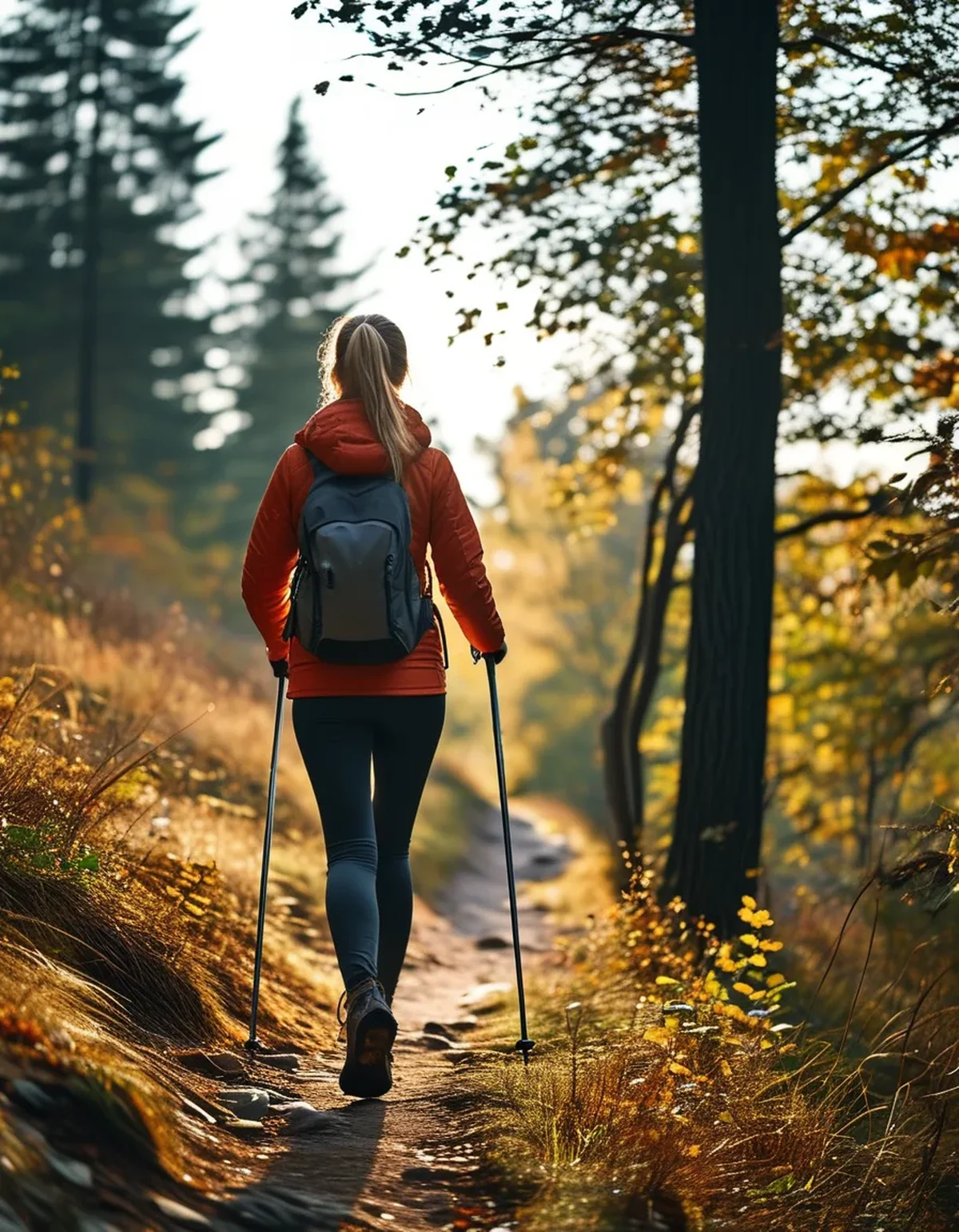
How to practise it without a mountain
Most people learn this badly because they only meet real descents occasionally, and they meet them when they are already tired.
Use the shallow slope near you deliberately. Any short hill will do. Walk down it four or five times, focusing on one thing per repetition: plant position, then pole length, then stride length, then grip.
Count the plants. On a descent you want a plant on every step, not every other one. If your poles are only touching down half the time, they are not sharing load — they are along for the walk.
Listen for the tips. A correct descending plant makes a distinct, consistent tap ahead of you. Irregular or absent contact tells you the timing has slipped without you having to look down.
Do the return leg on purpose. If you always climb one route and descend another, you may be practising the descent on the leg where you are most tired. Reversing the loop occasionally means you get to learn the technique fresh.
Autumn is a good and slightly risky time to do this work. Wet leaves reduce tip grip substantially, and a pole that skates out on a descent is worse than no pole. Rubber paws slip more on wet leaves than metal tips do, so on leaf-covered descents the bare tip is usually the safer choice, and planting slightly more vertically helps it bite.
5 mistakes on downhill nordic walking
1. Keeping flat-ground pole length for the whole walk. Convenient, and it makes every descent worse. If your poles adjust, use the feature — that is what it is for.
2. Leaning back. It feels like braking and it puts your weight behind your feet, which reduces traction and loads the knees. Stay upright with a slight forward inclination from the ankles.
3. Reaching too far ahead. There is a middle position. A pole planted far out in front cannot take load smoothly and jars the shoulder when your weight arrives. Slightly ahead of the leading foot, not a stride ahead.
4. Running the descent. Letting gravity take over feels efficient and eliminates the pole action entirely. If you want to run downhill that is fine — but it is a different activity, and the poles become a hazard rather than an aid.
5. Ignoring it because the descent feels easy. Cardiovascularly it is easy, which is exactly why people do not pay attention. The load is mechanical rather than metabolic, and it accumulates without feeling like effort.
FAQ: Downhill Nordic Walking Questions, Answered
Do I really need to adjust pole length mid-walk?
On a rolling route with short ups and downs, no — that becomes impractical. On a sustained descent of ten minutes or more, yes, and it makes a clear difference.
Are the straps dangerous on descents?
Straps are a genuine consideration on steep or technical ground, since a pole that catches while your hand is secured can twist a wrist. Many walkers loosen or come out of the straps on steeper descents. Use your judgement about the terrain.
Does this help if I have knee problems?
Poles used correctly reduce the load going through the knee on descents, which is one of the better-supported reasons to use them at all. Whether that is appropriate for your particular knee is a question for a physiotherapist or clinician.
Should I use a different tip for descending?
Not different, but check the one you have. Worn tips lose grip fastest exactly where you need it most, and tip wear is easy to ignore because it happens gradually.
Why do my shoulders ache after a hilly walk?
Usually from over-reaching on descents or from gripping too hard throughout. A correct plant loads the pole through the arm in line rather than at an awkward angle, and it should feel like support rather than effort.
TL;DR:
- Uphill the pole pushes behind you; downhill it must plant ahead to absorb load.
- Lengthen poles 5 to 10 cm for sustained descents, or grip lower on fixed poles.
- Hold the grip rather than relying on the strap, and shorten your stride.
- Aim for a plant on every step; irregular contact means the poles are not sharing load.
- On wet autumn leaves, bare tips grip better than rubber paws.
The descent is where nordic walking has the most to offer and where most people use it least. Three adjustments turn the poles from passive to protective.
This is general information, not medical advice.
See It in Motion
Seen here: Super High Waist Embossed Yoga Leggings with Inner Pocket — shop it on bubblelime.com
Keep Reading
This article is for general informational and styling purposes only. Fit, sizing, and product availability may vary.