Why Nordic Walking Pole Straps Loosen Unevenly on One Side More Than the Other
Quick Answer: A pole strap that consistently loosens on one side more than the other usually reflects a genuine asymmetry in push-off force and hand grip pattern between the dominant and non-dominant side — most people unconsciously push off more forcefully through their dominant-side pole, which works the strap and glove interface harder on that side and loosens it faster than the passive, lighter-gripping non-dominant side.
A strap that keeps loosening on one specific side isn’t a manufacturing or equipment flaw — it’s usually a visible signal of an asymmetric push-off pattern most nordic walkers don’t consciously notice they have.

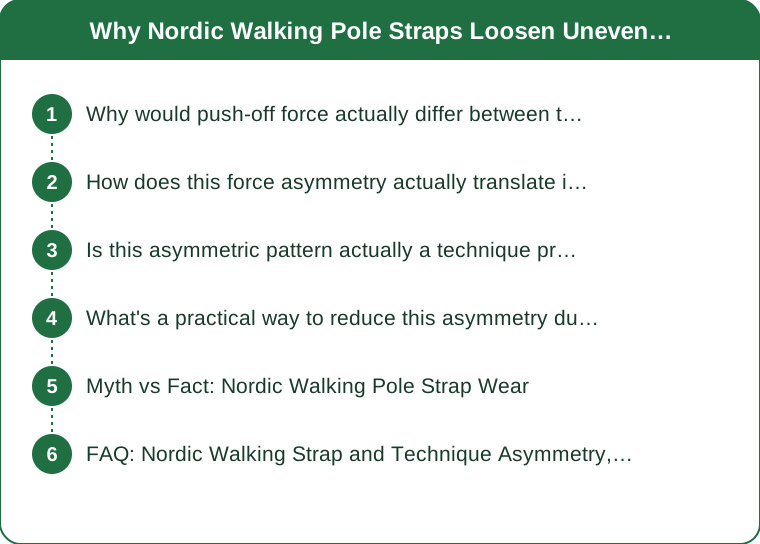
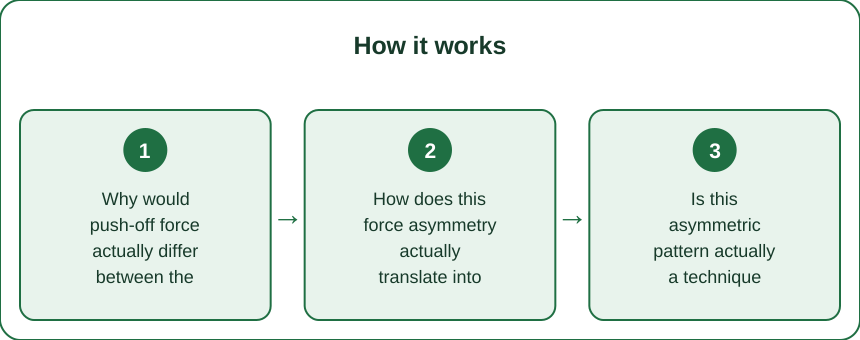
Why would push-off force actually differ between the dominant and non-dominant side during nordic walking?
Most people have a naturally dominant side with greater unconscious grip strength and force output, and in nordic walking specifically, this often translates into a more forceful, decisive pole plant and push-off on the dominant side compared to a comparatively lighter, more passive motion on the non-dominant side. This asymmetry is common even among people who don’t notice any strength imbalance in other daily activities, since the coordinated pole-and-stride motion is a less familiar movement pattern than everyday tasks.
How does this force asymmetry actually translate into one strap loosening faster?
A more forceful push-off repeatedly works the hand against the strap and glove interface with more shifting and micro-movement than the lighter, more passive non-dominant side, and this repeated shifting gradually loosens the strap’s tension over the course of a session. The dominant-side strap essentially experiences more wear-inducing movement per stride than the non-dominant side does, which is a direct mechanical consequence of the force asymmetry.
Is this asymmetric pattern actually a technique problem worth correcting, or just a normal individual variation?
It’s worth at least noticing, since balanced push-off force between both sides is part of correct nordic walking technique and is associated with better overall workout effectiveness and reduced strain on any one side of the body. A pronounced asymmetry, beyond typical minor individual variation, can be a useful signal to bring conscious attention to the weaker or more passive side during a session.

What’s a practical way to reduce this asymmetry during a walk?
Consciously focusing on matching push-off force and pole plant timing on the non-dominant side, particularly during the first few minutes of a session when form is most consciously controllable, helps rebalance the pattern over time. Some nordic walking coaches also recommend deliberately leading with the non-dominant side pole plant periodically during a session as a way to build more symmetric strength and coordination.
Myth vs Fact: Nordic Walking Pole Strap Wear
Myth: A strap loosening faster on one side means that pole’s strap mechanism is defective. Fact: This is usually a technique and force-asymmetry issue rather than an equipment problem, and adjusting both straps evenly at the start of each session addresses the practical symptom.
Myth: Push-off asymmetry between sides is unusual and worth medical concern. Fact: Mild dominant-side asymmetry is common and normal in nordic walking, particularly for newer practitioners — pronounced or worsening asymmetry over time is more worth attention than a mild, stable pattern.
FAQ: Nordic Walking Strap and Technique Asymmetry, Answered
Is there a strap style less prone to this loosening pattern?
Some strap designs with a more secure locking mechanism (rather than a simple hook-and-loop adjustment) hold tension more consistently through a session regardless of the force asymmetry, which can be worth considering for anyone finding this a persistent annoyance.
Should the dominant-side strap just be set tighter from the start to compensate?
This is a reasonable practical workaround for the symptom, though it doesn’t address the underlying force asymmetry — combining a slightly tighter starting strap with conscious non-dominant side focus addresses both the symptom and the cause.
Does this asymmetry tend to improve naturally with more nordic walking experience?
Yes, often — as coordination and bilateral strength develop with regular practice, many nordic walkers report the asymmetry becoming less pronounced over weeks to months of consistent practice.
TL;DR:
- A pole strap loosening faster on one side usually reflects a real dominant-side push-off force asymmetry
- The dominant side’s more forceful pole plant works the strap-glove interface harder, loosening it faster
- Consciously matching push-off force on the non-dominant side helps rebalance the pattern over time
- This asymmetry is common, especially for newer practitioners, and often improves naturally with more practice
An unevenly loosening pole strap is a genuinely useful, visible signal of push-off asymmetry — noticing it and consciously balancing effort between both sides improves both the strap issue and overall nordic walking technique.
See It in Motion
Seen here: High Waist Jogger Sweatpants with Pockets — shop it on bubblelime.com
Keep Reading
This article is for general informational and styling purposes only. Fit, sizing, and product availability may vary.