Why Nordic Walking on a Treadmill Does Not Work - and What to Do Indoors
Quick Answer: Nordic walking works because you plant a pole into a fixed surface and push backward against it, which propels you forward and loads the arms, chest, and back. On a treadmill the surface is moving toward you, so there is nothing stationary to push against - the pole either drags or gets caught, and the propulsive element disappears. Indoors, the effective substitutes are a resistance band pull-back drill, an incline treadmill walk with weighted poles held actively, or a ski erg, all of which recreate the pushing pattern the belt removes.
Useful to know now, before the weather makes indoor options the default.

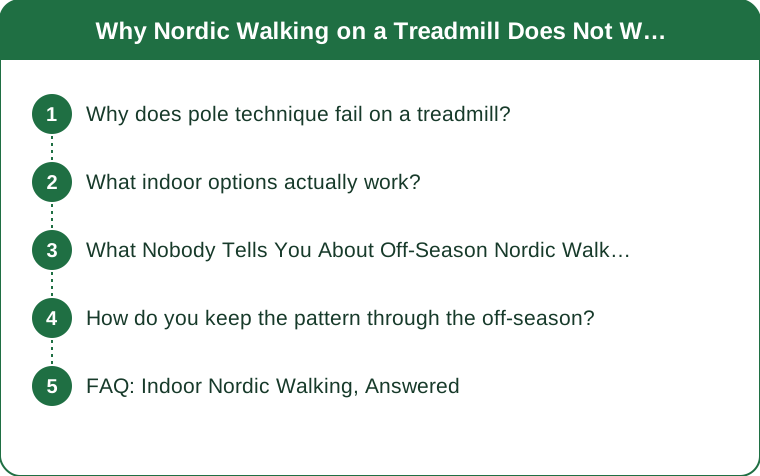
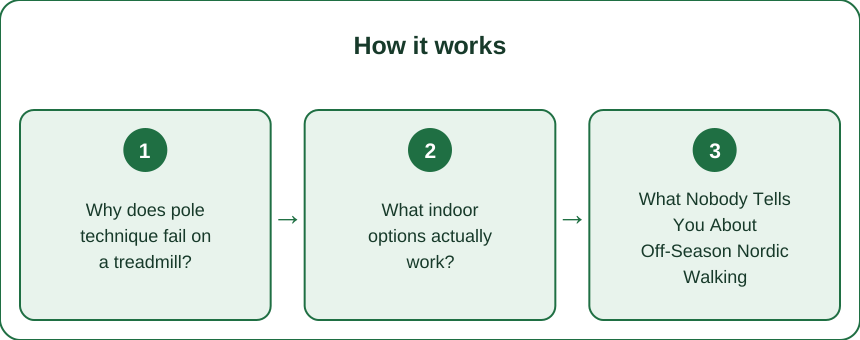
Why does pole technique fail on a treadmill?
Because the mechanism depends on a stationary ground reference.
Nordic walking is a pushing sport, not a swinging one. The pole tip plants behind you, you press down and back through it, and that push contributes real propulsion. Measured energy cost rises meaningfully compared with ordinary walking specifically because of the push, not because you are moving your arms more.
A treadmill belt removes the fixed reference. The moment the tip touches the belt, the belt carries it backward at speed. You cannot push against something already moving away from you faster than you can push - the tip is swept back and the pole becomes a pendulum.
And it is genuinely unsafe. A pole tip that catches the belt edge or the deck frame can jam and either break the pole or pull you sideways. Treadmill decks are also narrow, which means the wide, low pole angle that good technique requires does not physically fit.
What you are left with is arm swinging. It looks like nordic walking, it burns marginally more than walking with your hands free, and it delivers almost none of the upper-body loading that makes the sport worth doing. The forearms and shoulders that usually fatigue first will feel fine, which is the giveaway.
What indoor options actually work?
Four, in order of how closely they reproduce the real pattern.
1. Ski erg or double-poling machine - closest match. The double-poling motion is essentially nordic walking’s push isolated and loaded. Ten minutes of intervals on a ski erg produces more upper-body training effect than an hour of treadmill arm swinging. Many gyms now have one, and it is usually free.
2. Resistance band pull-backs while walking in place. Anchor a long band at chest height in front of you, hold a handle in each hand, and replicate the plant-and-push motion in time with your steps - arm forward at around 45 degrees, then drive down and back until the hand passes your hip. Three sets of 60 seconds per arm alongside your usual walk. This trains the exact muscle sequence.
3. Incline treadmill walking with poles held, not planted. Set an incline of 5 to 10 percent, hold light poles or 1kg weights, and actively drive the arms through full range with the elbow extending behind you. It is not real nordic walking, but combined with the incline it produces a comparable heart rate and preserves the movement pattern.
4. An indoor hall or corridor with rubber tips. If you have access to a sports hall or a long indoor space, rubber paw tips on a solid floor work exactly as they do outdoors. Many nordic walking groups move indoors in winter for precisely this reason.
Avoid: treadmill with poles planted, and pole work on a smooth polished floor without rubber tips - the second is a slip risk rather than a training limitation.

What Nobody Tells You About Off-Season Nordic Walking
The technique degrades faster than the fitness. Two months of arm-swinging substitutes and the pole plant timing goes. When you return outdoors, the first few sessions feel awkward in a way that fitness does not explain - it is a motor pattern problem, and it comes back within about three sessions if you deliberately focus on the plant.
Grip and forearm conditioning fades quickest of all. These are the tissues that adapted specifically to pole work, and they detrain fast without the loading. The blisters and forearm ache of your first spring session are the price of an unloaded winter - a weekly band session largely prevents it.
Cold-weather outdoor walking is more available than people assume. Nordic walking tolerates cold considerably better than running because the effort is steady and the arms stay busy. Wet leaves and ice are the real limits, not temperature - and a carbide tip handles more than a rubber paw will.
Gloves change your technique without telling you. Thicker winter gloves alter how the strap loads your hand, and most people unconsciously grip harder to compensate. Loosening the strap slightly for gloved sessions fixes a surprising amount of winter forearm ache.
And the shoulder is the joint that notices a long break. Returning to full pole volume after two months off is the classic route to shoulder irritation. Build back over two to three weeks rather than resuming at your autumn volume.
How do you keep the pattern through the off-season?
A minimal weekly structure that preserves the specific adaptations.
One band session a week, ten minutes. Three sets of 60 seconds per arm of the pull-back drill, plus two sets of 15 straight-arm pulldowns with the band anchored high - that second exercise trains the lat engagement that drives the pole push. Ten minutes weekly is enough to hold the pattern.
One grip session, five minutes. Farmer’s carries with any two heavy objects for 40 seconds, three rounds. This maintains the forearm endurance that fails first, and it is the difference between a comfortable spring return and two weeks of blisters.
Keep walking, poles or not. The leg and cardiovascular side of nordic walking is maintained by any walking. Do not stop walking because you cannot use poles - the aerobic base is the easy part to hold.
Get outdoors with poles at least twice a month if conditions allow. Even a 20 minute session preserves the timing that nothing indoors quite reproduces. Carbide tips, a route you know, and daylight are the three conditions worth insisting on.
And use the off-season to fix technique rather than just maintain it. Winter is a good time to record 30 seconds of yourself from the side and check the two things that go wrong most: pole planting too far forward (it should land at or behind the front foot) and the hand not opening at the end of the push. Both are easier to correct deliberately in a controlled indoor session than on a trail.
This is general information, not medical advice - shoulder or elbow pain that persists is worth having looked at rather than training through.
FAQ: Indoor Nordic Walking, Answered
Can I use nordic poles on a treadmill at all?
Not with a genuine plant and push - the belt sweeps the tip backward and it can catch. Holding poles and driving the arms through full range on an incline is a reasonable substitute, but it is not the same exercise.
Does an elliptical with moving handles count?
It trains a broadly similar upper-body contribution and is a decent cardio substitute, but the pushing mechanics differ - the handles move on a fixed path rather than requiring you to generate the push against ground.
What is the single best indoor substitute?
A ski erg, if you have access to one. The double-poling motion is essentially the nordic push isolated and loaded, and short intervals transfer well.
How much fitness will I lose over a winter indoors?
Aerobic fitness holds well if you keep walking. What fades is grip, forearm endurance, and pole timing - all of which a ten minute weekly band session largely preserves.
Are rubber tips safe on indoor floors?
On rubber, wood sports floors, and most matting, yes. On polished or wet smooth floors they can slip. Test cautiously before committing weight to the pole.
Why do my forearms ache more indoors than outdoors?
Usually because band work loads continuously while pole walking loads in short bursts with a release phase. That is not a problem - just build volume gradually.
TL;DR:
- Nordic walking works by pushing against a fixed surface; a treadmill belt moves away from the tip, so the push - and the training effect - disappears.
- It is also a genuine safety risk, since a caught tip can jam or pull you sideways.
- Best indoor substitutes: ski erg, resistance band pull-back drills, incline treadmill with poles held actively, or a sports hall with rubber tips.
- Grip and forearm endurance fade fastest - ten minutes of band work plus five minutes of carries per week holds them.
- Use the off-season to film your plant timing and fix technique, then rebuild volume over two to three weeks in spring.
The poles are not doing nothing on a treadmill - they are doing arm swinging, which is a different and much smaller exercise. Move the push somewhere it has something to push against.
This is general information, not medical advice.
See It in Motion
Seen here: High Waist Jogger Sweatpants with Pockets — shop it on bubblelime.com
Keep Reading
This article is for general informational and styling purposes only. Fit, sizing, and product availability may vary.