Why Nordic Walking Makes Your Forearms Ache Before Your Shoulders
Quick Answer: Forearm ache in Nordic walking almost always means you are gripping the poles instead of using the straps. Correct technique has you push through the strap with an open hand for most of the stroke, so the force transfers through the wrist rather than through your fingers. Gripping continuously loads the forearm flexors isometrically for the whole session, which is why they fatigue before the larger muscles you are trying to train. The fix is strap adjustment plus deliberately opening the hand at the end of each push.
The promise of Nordic walking is that it recruits your upper body, which is why it burns more than ordinary walking.
So when the first thing that hurts is your forearms, something in the chain is wrong. It is a technique issue, it is extremely common, and it is fixable in one session.
What is the grip supposed to be doing?
Almost nothing, which is the part that surprises people.
How force actually transfers in correct technique. The pole strap, properly a glove-style or half-glove strap on Nordic-specific poles, wraps around your hand between the thumb and index finger. When you push down and back, the force goes from your arm into the strap, and from the strap into the pole. Your fingers are not required for this.
The sequence in one stroke:
- Plant. The pole tip touches down behind you at an angle, and you close your hand lightly around the grip.
- Push. You press down and back through the strap. Grip pressure stays light.
- Release. As the pole passes your hip, your hand opens completely, and the pole swings forward hanging from the strap.
- Recovery. The hand stays open or barely closed while the pole swings through.
The open hand is the diagnostic. In correct technique your hand is fully open for a meaningful part of every stroke. If your hand never opens, you are gripping continuously, and continuous grip is the source of the forearm ache.
Why beginners grip. Holding a stick tightly is instinctive, particularly if the strap is loose or unfamiliar and the pole feels like it might fall. The instinct is reasonable and it is exactly what the strap system exists to make unnecessary.
Why do the forearms fatigue so fast?
Because of what kind of contraction they are doing and how long it lasts.
Isometric contraction fatigues faster than dynamic contraction. Gripping is a sustained hold rather than a repeated movement. Sustained holds restrict blood flow within the working muscle, so metabolites accumulate and the muscle fatigues considerably faster than one that alternates contraction and relaxation.
The duration is the problem. In a 45-minute walk, a continuous grip is a 45-minute isometric hold at low intensity in a small muscle group. The forearm flexors are not large muscles and they were not the intended target.
What happens when they fatigue:
- Grip strength declines, so you grip harder to compensate, which accelerates it
- You lose the push through the strap, since a tired hand does not open properly
- The whole technique degrades toward carrying poles rather than using them, at which point Nordic walking becomes walking with extra weight in your hands
The compounding effect on the intended muscles. If your forearms fail, the triceps, lats, and posterior shoulder never receive the load they were supposed to. So the symptom is a forearm ache and the actual cost is that the exercise stopped doing what it was for.
A related sign: if your poles feel heavier at the end of the walk, that is grip fatigue rather than the poles changing. Well-fitted poles should feel roughly the same at minute 40 as at minute 5, because you are not holding them up.
How do you actually fix it?
Strap setup first, then a specific drill, then check pole length.
Step 1: adjust the straps properly. This is where most of the problem lives.
- The strap should be snug, not loose. A loose strap forces you to grip, because the pole is not connected to your hand.
- Sized so that with your hand open and relaxed, the pole hangs from the strap without dropping. Test this standing still: open your hand completely. The pole should hang and stay.
- The strap should sit in the web between thumb and index finger, not around the wrist. This is where the force transfers.
- Left and right straps are usually handed on Nordic poles and are marked L and R. Swapping them makes the fit wrong and forces gripping.
Step 2: the open-hand drill. Walk 100 metres deliberately opening your hand completely at the end of every push, exaggerating it. It feels like you are about to drop the poles and you will not, because the strap holds them. Do this at the start of every walk for two weeks and it becomes automatic.
Step 3: check pole length. Poles that are too long force a higher hand position and encourage gripping. The standard guideline is your height multiplied by roughly 0.68, and with the tip on the ground beside you, your elbow should be at about 90 degrees.
Step 4: check your shoulders. Shrugged shoulders and gripping tend to travel together. Consciously dropping your shoulders often releases the hands as well.
A useful cue that works for many people: think of the hand as a hook rather than a fist. The fingers are there to catch the grip on the way forward, not to hold it during the push.
What Nobody Tells You About Grip and Poles
Blisters between thumb and index finger mean the strap is doing its job. This is where the force transfers, so some friction there is expected while you adapt. Blisters in the palm mean the opposite, that you are gripping. The location of your blisters is a free technique diagnosis.
Trekking poles and Nordic poles are different tools. Trekking poles have simple loop straps designed for weight-bearing support on descents, and they are used with a grip. Nordic poles have glove-style straps designed for push-off force transfer. Using trekking poles for Nordic walking forces the gripping pattern, and this is a very common reason people cannot get the technique to work.
Cold weather increases gripping substantially. Cold hands grip harder involuntarily, and thick gloves reduce tactile feedback so you compensate with pressure. Thin gloves with good grip material are better than thick ones for this, and warming your hands before starting genuinely helps.
Forearm ache and tennis elbow are related here. Persistent gripping loads the wrist extensor tendons at the lateral elbow. If your forearm ache is becoming a specific point of pain on the outside of the elbow, that is worth addressing with technique changes and rest rather than continuing.
Grip strength does improve with practice, and that is not the goal. Some people conclude they need stronger forearms. You need less forearm involvement, not more capacity for an unnecessary contraction.
Pole weight matters more than people expect for this. A heavier pole requires more effort to swing forward, which encourages gripping during recovery. Carbon poles are lighter than aluminium and the difference is noticeable over an hour.
The strap release mechanism is worth having. Better Nordic poles have a clip that releases the strap from the pole, so you can free your hands without unstrapping. This removes the temptation to keep the straps loose enough to slip out of, which is a common cause of the whole problem.
Seasonal note: autumn brings wet leaves and cold mornings, both of which increase gripping. Wet conditions make the poles feel less secure, and cold makes hands tighten. This is the season the forearm ache typically reappears in people who had solved it in summer, and the fix is the same open-hand drill rather than a new technique.
This is general information, not medical advice. Persistent elbow or forearm pain that does not respond to technique changes and rest warrants assessment.
FAQ: Nordic Walking Grip Questions, Answered
Why do my forearms hurt after Nordic walking?
You are gripping the poles instead of pushing through the straps. A continuous grip is a sustained isometric contraction in a small muscle group for the whole walk, which fatigues far faster than the larger muscles the technique is meant to load.
How tight should Nordic walking pole straps be?
Snug enough that with your hand fully open and relaxed, the pole hangs from the strap without dropping. A loose strap forces you to grip, which is the source of most technique problems.
Can I use trekking poles for Nordic walking?
Not well. Trekking poles have simple loop straps designed for weight-bearing support, not the glove-style straps that let you transfer push-off force with an open hand. They force the gripping pattern that causes forearm fatigue.
TL;DR:
- Forearm ache means you are gripping instead of pushing through the strap. The hand should open fully every stroke.
- Set the strap snug enough that the pole hangs from an open hand without dropping.
- Blisters between thumb and index finger are correct. Blisters in the palm mean gripping.
- Trekking poles cannot do this. The strap design is the difference, not the pole.
On your next walk, spend the first 100 metres deliberately opening your hand at the end of every push. Two weeks and it stops being a decision.
See It in Motion
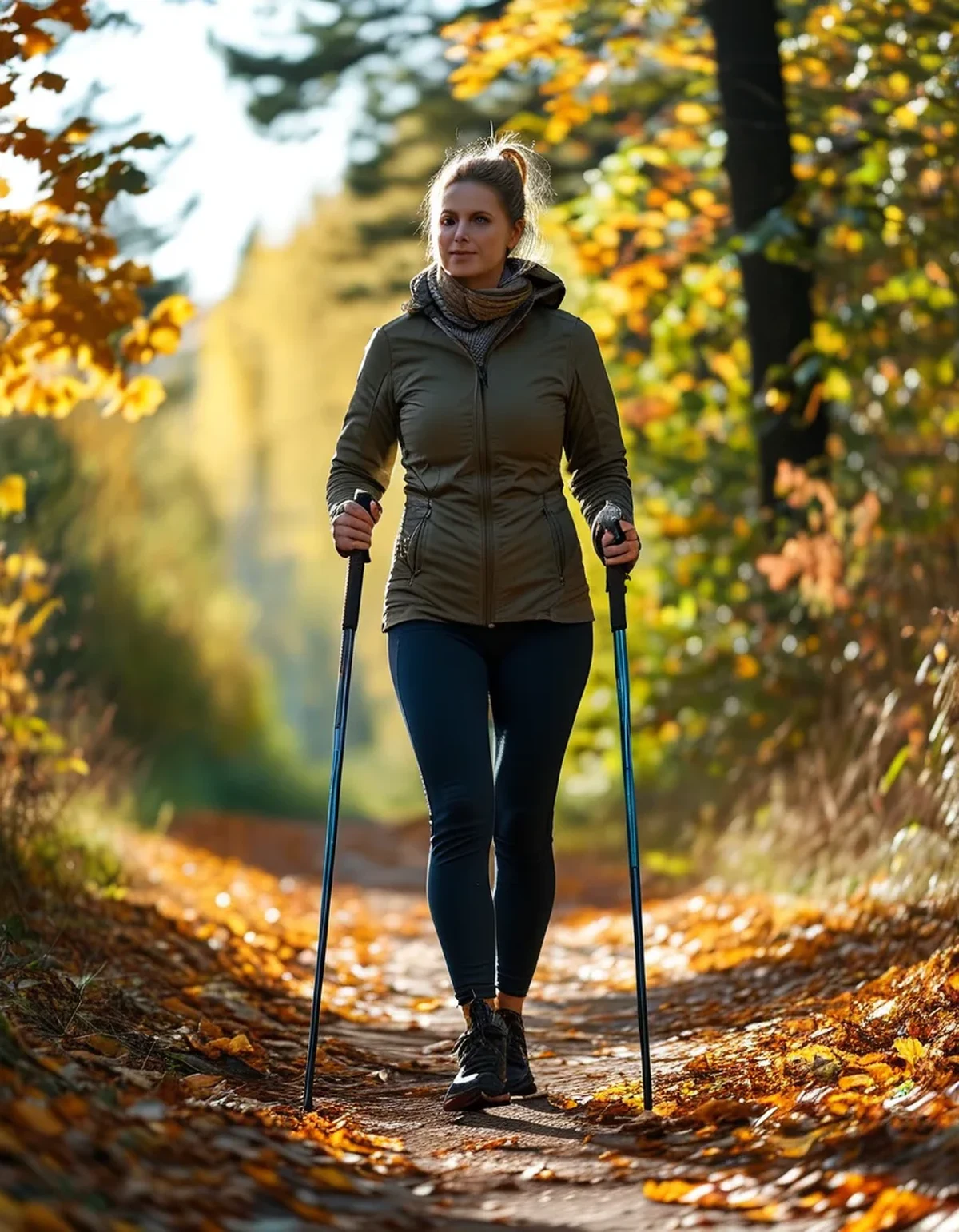
Seen here: Super High Waist Embossed Yoga Leggings with Inner Pocket — shop it on bubblelime.com
Keep Reading
This article is for general informational and styling purposes only. Fit, sizing, and product availability may vary.