Why Your Nordic Walking Heart Rate Drops When You Get Tired
Quick Answer: Nordic walking raises heart rate above regular walking because the upper body is actively pushing through the poles. As the smaller upper-body muscles fatigue - typically 30 to 45 minutes in for most people - the push weakens, the poles start being carried rather than driven, and heart rate falls back toward normal walking levels. The walk feels easier because it has become an easier activity.
A falling heart rate mid-walk is a technique signal, not a fitness one.

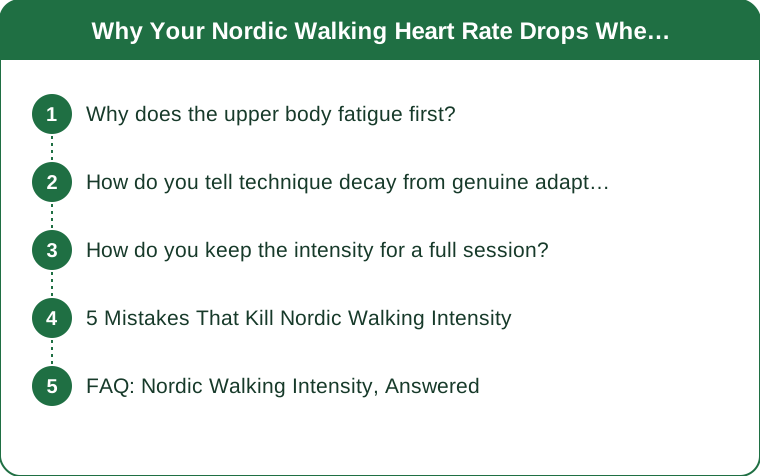
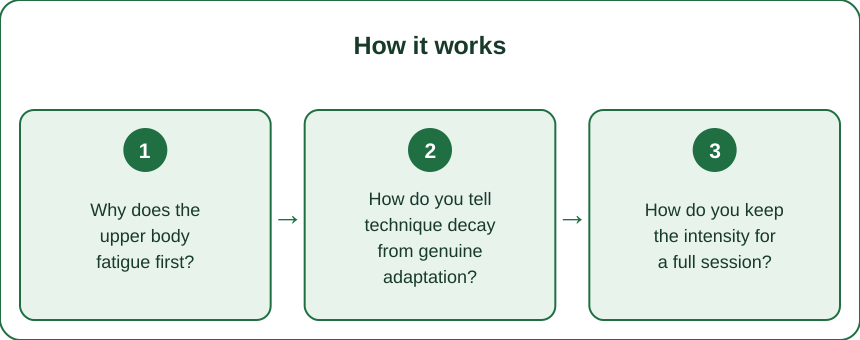
Why does the upper body fatigue first?
Because it is doing unfamiliar work with much less muscle mass than your legs.
Proper Nordic walking technique is not about planting poles for balance. It is an active push - the pole plants behind the body’s midline at an angle, and triceps, lats, and the posterior shoulder drive backward against it. That push is what makes the activity meaningfully harder than walking, and studies typically find energy expenditure rising by roughly 18 to 25 percent over walking at the same speed with good technique.
The muscles doing that work are small and untrained for it. Triceps and posterior deltoid are a fraction of the mass of your legs, and for most people they have never done 45 minutes of continuous rhythmic contraction. Legs are conditioned by daily walking; the pushing muscles are not conditioned by anything.
So the fatigue sequence is predictable:
- Minutes 0 to 20: technique is good, push is strong, heart rate is elevated appropriately
- Minutes 20 to 35: the push starts to shorten, often without you noticing
- Minutes 35 onward: poles are being placed rather than driven, arms swing from the shoulder without force, heart rate drops toward walking level
- The subjective experience: it gets easier, and it feels like you are warmed up and moving well
Technique decay is what a heart rate drop is measuring, in almost every case. It is the same phenomenon as a runner’s form falling apart late in a session, except that in Nordic walking the consequence is a quieter one - the workout simply stops being the workout.
The forearm signal is the giveaway. If your forearms ache before your shoulders and triceps do, you are gripping rather than pushing - which means the strap is not doing its job and the drive is coming from the hand instead of the back. That is the most common technique fault and it fatigues you quickly for very little cardiovascular return.
How do you tell technique decay from genuine adaptation?
Four checks, and the first one settles it.
1. Timing within the session. Genuine fitness improvement shows up as a lower heart rate at the same effort across weeks, not within a single walk. A drop 40 minutes into today’s session, when the first 20 minutes were at the usual rate, is technique. A gradual month-over-month decline at the same route and pace is adaptation.
2. Where the fatigue is. Technique decay is preceded by upper-body fatigue - triceps, shoulders, forearms, or upper back. If your arms are tired before your heart rate falls, that is the mechanism.
3. The pole-lift test. Mid-walk, deliberately return to a strong push for 30 seconds and watch your heart rate. If it climbs straight back up, technique was the variable. If it stays down, you may genuinely be fitter or you may have slowed your walking pace without noticing.
4. Check your speed. Walking pace often drops as technique fades, and a slower walk is a lower heart rate for ordinary reasons. GPS pace data separates this immediately.
Other things that lower heart rate mid-walk and are worth ruling out:
- Cooler weather. Heart rate runs lower in cool conditions at the same effort, which matters as autumn arrives - an autumn walk at 55 degrees genuinely produces a lower heart rate than the same walk at 80 degrees in August.
- Cardiac drift in reverse - if you started dehydrated or overheated, heart rate can settle as you find a rhythm
- Terrain. An out-and-back route with a climb at the start naturally shows a falling heart rate on the return
- Chest strap contact. Optical wrist sensors are unreliable during pole work because of wrist movement and grip tension. A chest strap is considerably more accurate for this activity specifically, and a wrist reading that drops mid-walk may simply be a sensor losing contact.

How do you keep the intensity for a full session?
Build the upper body’s endurance and structure the walk so decay is visible.
Fix the strap technique first. The strap should carry the load, not your grip. With a correctly fitted strap, you can open your hand at the end of the push and the pole stays connected. This lets the larger back muscles drive the push rather than the forearms holding on, and it is the single most effective change for extending how long good technique lasts. If your forearms ache first, this is your fix.
Check pole angle. The pole should plant at roughly 60 degrees, angled backward, behind the front foot - never vertical. A vertical pole cannot be pushed against, which turns Nordic walking into walking while holding sticks. This is the most common reason the heart rate benefit never appears at all.
Build upper-body endurance directly. Two short sessions a week: push-ups or incline push-ups, band pull-aparts, triceps extensions, and rows, in the 12 to 20 rep range for endurance rather than heavy strength. Six to eight weeks noticeably extends how long the push holds up.
Use intervals to reset technique. Three minutes of strong push, two minutes of relaxed walking, repeated. The relaxed blocks let the upper body recover, so the pushing blocks stay strong for the full session. This produces a higher average intensity than trying to push continuously and fading, which is the same principle that makes interval running effective.
Start shorter than you want to. If technique holds for 30 minutes, walk for 30 minutes with good technique rather than 60 with 30 of them wasted. Extend by five minutes a week.
Watch the heart rate live and treat a drop as a cue. A visible fall is your prompt to check the push, not a reason to feel pleased. Some people find one glance at the watch resets the technique entirely for another ten minutes.
Film yourself once. From the side, 30 seconds, at the start and again at minute 40. The difference is usually obvious and it is far more convincing than any description, because most people genuinely believe their technique is holding.
5 Mistakes That Kill Nordic Walking Intensity
1. Planting the pole vertically. A vertical pole is a walking stick. The angle backward is what allows a push, and without it the whole upper-body contribution disappears.
2. Gripping instead of using the strap. Gripping fatigues the forearms fast and shifts the work away from the back muscles that should be driving. If your forearms burn first, the strap is not set up correctly.
3. Walking too long for your current upper-body endurance. Thirty good minutes beats sixty with half of them spent carrying poles. Extend gradually.
4. Judging the session by how it felt. It feels easier precisely when the intensity has dropped. Feeling good at minute 45 is often the symptom rather than the reward.
5. Trusting a wrist heart rate monitor. Wrist optical sensors struggle with pole work because of wrist movement and grip pressure. A chest strap is substantially more accurate for this activity.
FAQ: Nordic Walking Intensity, Answered
Is a dropping heart rate always bad?
Within a single session, it usually means technique has faded. Across weeks at the same route and pace, it means you are fitter. The timescale distinguishes them.
How much should Nordic walking raise my heart rate?
With good technique, expect a meaningful increase over walking at the same speed - studies commonly find energy expenditure up 18 to 25 percent. If there is no difference at all, check pole angle first.
Why do my forearms ache more than my shoulders?
You are gripping the pole rather than pushing through the strap. Correct strap setup shifts the work to the back and triceps and extends how long technique lasts.
Should I do upper-body strength work?
Yes - it is the direct fix for technique decay. Two short sessions a week in the 12 to 20 rep range, and six to eight weeks makes a visible difference.
Does cooler autumn weather lower my heart rate?
Yes, genuinely. Heart rate runs lower in cool conditions at the same effort, so comparing autumn walks to summer ones will show a drop that has nothing to do with technique or fitness.
TL;DR:
- Nordic walking raises intensity through an active backward pole push, driven by small upper-body muscles that fatigue quickly.
- A heart rate drop 30 to 45 minutes into a walk is almost always technique decay, not fitness.
- Distinguish them by timescale - within a session is technique, across weeks at the same route is adaptation.
- Fix strap technique so the back drives the push, and check that the pole plants at about 60 degrees behind the front foot.
- Use 3-on, 2-off intervals and build upper-body endurance twice a week to extend how long good technique holds.
Walk 30 minutes with a real push rather than 60 minutes carrying poles for half of it.
See It in Motion
Seen here: High Waist Jogger Sweatpants with Pockets — shop it on bubblelime.com
Keep Reading
This article is for general informational and styling purposes only. Fit, sizing, and product availability may vary.