Why Nordic Walking Poles Feel Awkward for the First Few Sessions (and When That Changes)
Quick Answer: The awkward phase with Nordic poles comes from learning a new cross-body coordination pattern (opposite arm and leg timing plus a controlled pole push) that isn’t used in regular walking. Most beginners report the movement starting to feel natural within 3-5 sessions of focused practice.
If your first Nordic walking session felt more like fighting the poles than gliding with them, that’s the normal learning curve — the coordination pattern is genuinely new, even for experienced walkers and runners.

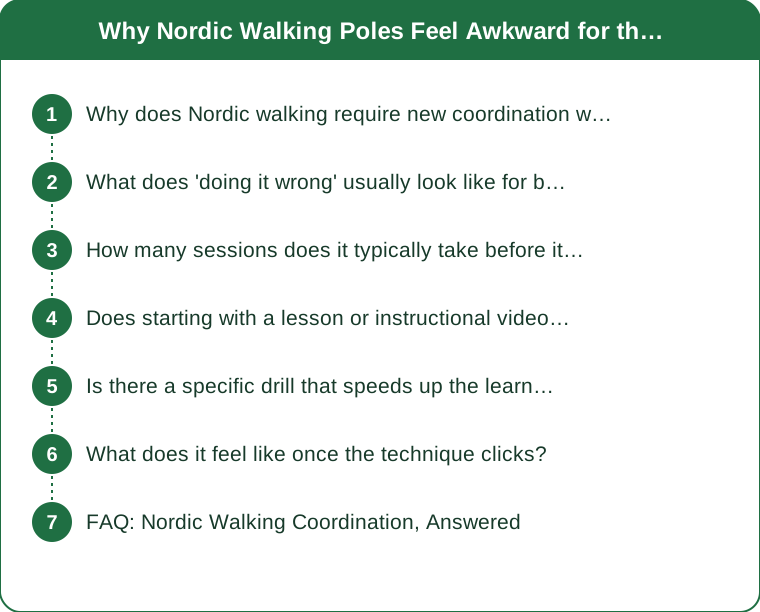
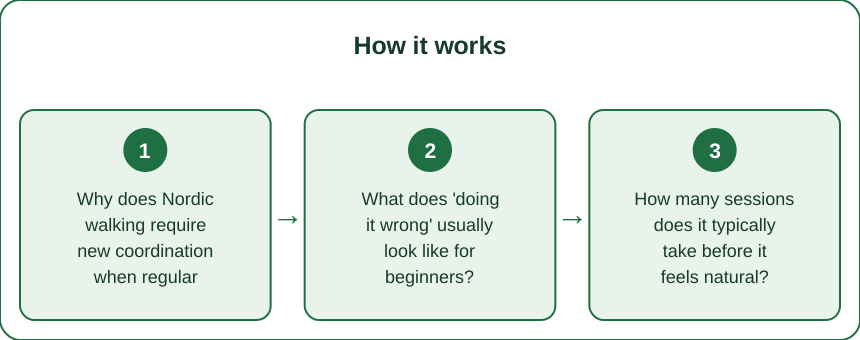
Why does Nordic walking require new coordination when regular walking doesn’t?
Regular walking already uses opposite arm-leg swing naturally and unconsciously, but Nordic walking adds a deliberate, timed pole plant and push-through that has to sync precisely with that existing swing — this timed push element is the genuinely new skill, not the arm-leg opposition itself, which is why it takes conscious practice.
What does ‘doing it wrong’ usually look like for beginners?
The most common early mistake is planting the pole too far forward and using it like a walking stick for support, rather than planting it slightly behind the body and pushing through for propulsion. This support-not-propulsion pattern feels more natural initially but doesn’t produce the upper-body engagement that’s the actual point of Nordic walking.
How many sessions does it typically take before it feels natural?
Most instructors and experienced walkers cite roughly 3-5 sessions of focused practice before the timing starts to feel automatic rather than deliberate — noticeably faster than many other new movement skills, likely because it’s building on an already-familiar walking gait rather than starting from zero.

Does starting with a lesson or instructional video actually matter?
It meaningfully speeds up the process — self-taught Nordic walkers often develop the ‘walking stick’ support habit and take longer to correct it than those who get early feedback on the push-through motion, since the incorrect pattern still feels functional enough that it doesn’t self-correct without input.
Is there a specific drill that speeds up the learning curve?
Practicing the arm swing and pole push without walking first (standing in place, focusing purely on the plant-and-push motion) before adding forward movement is a commonly recommended isolation drill — separating the new coordination element from the already-familiar walking motion reduces how much has to be learned simultaneously.
What does it feel like once the technique clicks?
Most people describe a shift from ‘thinking about the poles’ to the poles feeling like a natural extension of the walking rhythm — at that point the upper body engagement (the actual fitness benefit of Nordic walking over regular walking) starts happening automatically rather than requiring conscious effort.
FAQ: Nordic Walking Coordination, Answered
Is it normal to feel more tired in the arms than the legs at first?
Yes — new upper body engagement from the pole push is often the most noticeable new fatigue for beginners, and it typically moderates as the muscles adapt over the first few weeks.
Does pole length affect how awkward the learning phase feels?
Yes significantly — poles that are too long encourage the incorrect walking-stick support pattern, so correct length sized to your height is worth confirming early.
Should beginners practice on flat ground only at first?
Generally yes — mastering the basic push-through timing on flat, even ground before adding hills or uneven trail terrain reduces how many new variables are being learned at once.
TL;DR:
- Nordic walking’s awkwardness comes from a new timed pole push, not the arm-leg swing itself
- The most common beginner mistake is using poles as support sticks instead of propulsion tools
- Most people find the motion starts feeling natural within 3-5 focused sessions
- Isolating the pole push motion before adding walking speeds up the learning curve
The clumsy first few sessions are universal, not a sign you’re doing something wrong — give it a handful of sessions before judging whether it clicks.
See It in Motion
Seen here: High Waist Jogger Sweatpants with Pockets — shop it on bubblelime.com
Keep Reading
This article is for general informational and styling purposes only. Fit, sizing, and product availability may vary.