Your Nordic Walking Poles Are Probably the Wrong Length — Here's the Fix
Quick Answer: Nordic walking poles should be sized so your elbow sits at roughly a 90-degree angle when the pole tip touches the ground beside your foot. A common formula: your height in cm × 0.68. Too long makes you shrug; too short makes you hunch.
You tried nordic walking once, felt awkward and stabby instead of smooth, and figured it wasn’t for you. Before writing it off, check your pole length — it’s the single most common reason beginners quit in the first week.

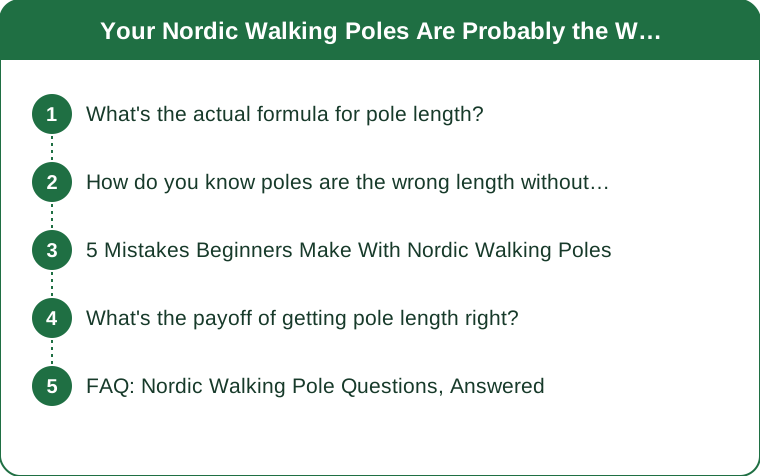
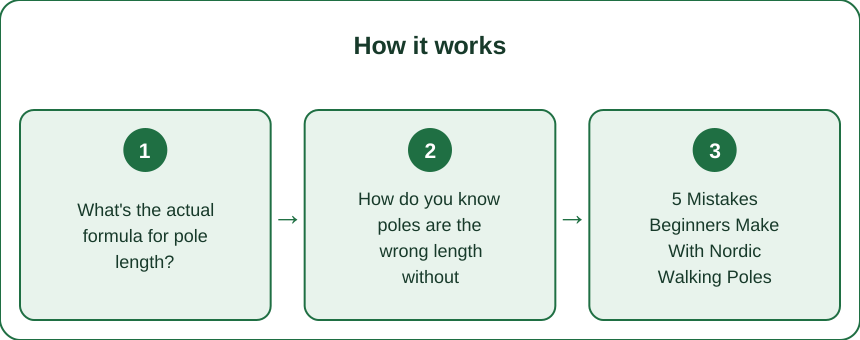
What’s the actual formula for pole length?
Multiply your height in centimeters by 0.68. A 165cm (5’5”) walker lands around 112cm poles. Most adjustable poles cover a 100-135cm range, so this is a starting point, not gospel — fine-tune from there.
How do you know poles are the wrong length without measuring?
Plant the pole tip beside your foot and grip the handle normally. Elbow bent near 90 degrees is right. If your shoulder shrugs up toward your ear, they’re too long. If you’re hunching forward to reach the handle, they’re too short.
Walk 20 steps. Poles that are correct disappear into the rhythm — you stop thinking about them. Wrong-length poles announce themselves every single stride.

5 Mistakes Beginners Make With Nordic Walking Poles
1. Buying fixed-length poles before testing. Adjustable poles let you dial in fit before committing.
2. Gripping too tight. The strap does the work — a death grip on the handle causes forearm fatigue within 10 minutes.
3. Planting the pole too far forward. It should land beside your foot, not out ahead like a ski pole.
4. Ignoring the wrist strap adjustment. A loose strap means your grip compensates, tiring your hands fast.
5. Never re-checking length after the first walk. Comfort preferences shift in the first few sessions — recheck at walk 3.
What’s the payoff of getting pole length right?
Right-length poles turn nordic walking from ‘walking with sticks’ into a real upper-body workout — studies on the technique show meaningfully higher calorie burn and heart rate versus regular walking when the poles are used correctly. Wrong length cancels most of that benefit and just adds arm fatigue.
FAQ: Nordic Walking Pole Questions, Answered
Do nordic walking poles differ from hiking poles?
Yes — nordic poles have an angled rubber tip for pavement push-off and a glove-style strap for the propulsion technique; hiking poles are built for stability on uneven terrain, not power generation.
Can I use one fixed pole length for hills?
Adjustable poles let you shorten slightly for uphill and lengthen slightly for downhill, though most casual walkers keep one length for flat routes.
How long until nordic walking feels natural?
Most people find their rhythm within 3-4 sessions once pole length and strap tension are dialed in correctly.
TL;DR:
- Height (cm) × 0.68 = starting pole length
- Elbow near 90 degrees when tip touches ground = correct fit
- Loose grip, strap does the work, plant beside your foot not ahead
- Recheck length after your first 2-3 walks
Fix the length before you fix your technique — most ‘nordic walking isn’t for me’ verdicts are actually pole-length verdicts.
See It in Motion
Seen here: High Waist Embossed Yoga Leggings with Side Pockets — shop it on bubblelime.com
Keep Reading
This article is for general informational and styling purposes only. Fit, sizing, and product availability may vary.