Nordic Walking Pole Length: Why the Standard Formula Fails Some Bodies
Quick Answer: The standard formula — height in centimeters times 0.68, rounded to the nearest 5cm — is a population average that assumes average proportions, and it misses for the long-legged, the short-torsoed, the round-shouldered, and anyone learning or managing joint issues. The measurement that actually matters is the elbow test: gripping the pole tip-down beside your foot, your elbow should sit at 90 degrees or a touch more open — because pole length is really about arm-to-ground geometry, which torso-to-leg ratio changes at identical heights. Buy adjustable poles, set them by elbow angle, drop 2 to 5cm while learning technique, and re-check on hills, new boots, and every few years as posture evolves.
Two women, both 5’7”, per the chart both “115cm poles.” One has the torso of someone 5’9” and the other the legs of someone 5’9” — and the same pole puts one’s elbow at a cramped 80 degrees and the other’s at a floppy 100. The formula was never wrong; it was an average, and averages fit averages. Your elbow knows better, and it is standing right there.
Where does the 0.68 formula come from — and why does it miss?
It is a regression line through average bodies, doing what regression lines do.
The formula reverse-engineers a simple target: with the pole planted vertically at your side, your forearm should run roughly parallel to the ground — the geometry that lets the arm drive backward through a full, powerful swing. For a person of average proportions, grip height that achieves this lands near 68 percent of total height, so the multiplier became the industry chart, rounded into 5cm pole increments.
The miss is in the word average. Pole fit is arm-and-shoulder-to-ground distance, and height is only a proxy for it. Torso-to-leg ratio varies substantially between same-height people: long legs with a short torso put the shoulders — and hanging arms — lower relative to total height, wanting shorter poles than the chart says; a long torso raises the whole arm system, wanting longer. Arm length itself varies independently on top of that. The formula flattens all three variables into one number, which is exactly why it serves the middle of the population well and the edges poorly.
Add the dynamic factors height never sees — habitual posture (a rounded upper back effectively lowers the grip point), stride length, wrist and shoulder history, terrain — and the chart’s real status becomes clear: a starting point for setting an adjustable pole, not an answer for buying a fixed one. The next section replaces it with your own arm.
What is the elbow test — and how do you run it properly?
Ninety seconds, no chart, accurate for your actual body.
The setup: wear the shoes you walk in (sole thickness counts), stand tall on flat ground, and hold the pole vertical beside your foot — tip on the ground next to your little toe, hand in the strap on the grip.
The read: your elbow angle. The fitting standard is 90 degrees or slightly more open — roughly 90 to 100 — with your upper arm hanging relaxed at your side, not lifted. At 90, the forearm runs parallel to the ground and the classic technique geometry is in place; the slightly-open allowance reflects how modern instruction actually coaches, since a hair more openness supports the long backward push behind the hip where nordic walking’s power lives.
The common misreads: shrugging the shoulder up to meet a too-long pole (the fitting must happen with a dropped, relaxed shoulder); measuring barefoot then walking in cushioned trainers, which shortens everything by 2 to 3cm; and gripping without the strap when the strap is what positions your hand in real walking.
Then the calibrations the chart never mentions: learning technique runs better 2 to 5cm shorter than your final fit — a slightly short pole forgives timing errors and encourages the back-swing release, then grows with your skill (literally, via the adjustment collar). Sustained hills adjust in the terrain section below. And anyone managing shoulder, elbow, or wrist sensitivity should favor the shorter end of their range — a shorter pole reduces the load each plant sends up the arm.
Mark your dialed setting with tape or a paint pen. Twist-locks drift; your fit should not.
Adjustable versus fixed poles — does the choice settle the formula problem?
Mostly yes — adjustability converts sizing from a purchase risk into a dial, which is why it wins for nearly everyone off the chart’s center.
Adjustable (telescoping) poles span roughly 30cm of settings, covering technique growth, shoe changes, hill days, sharing between household members, and travel collapse for the suitcase. Their costs: modest extra weight, a locking mechanism that must be respected (twist-locks need firm tightening and periodic checks; lever-locks are more positive and glove-friendly), and slightly more vibration than a one-piece shaft. For beginners, mixed terrain, evolving posture, and every proportion the formula misses, adjustable is the straightforward call.
Fixed-length poles are what instructors and racers often prefer once their number is known: lighter, stiffer, silent, nothing to slip. They make sense as a second purchase — after an adjustable pole has revealed your true setting across a season of technique development — never as a first one bought off the height chart, which is precisely how off-average bodies end up owning the wrong pole permanently.
Two spec notes while choosing either: real nordic walking poles have the angled boot-shaped rubber paw and, critically, the strap-glove system — the wide strap or clip-in demi-glove that lets you release the grip on the back-swing, which is half the technique. Trekking poles with round tips and simple loops are a different tool for a different sport. And carbon versus aluminum is comfort versus economy: carbon damps the tick of each plant noticeably on paved paths, aluminum shrugs off airline handling and half the price.

What Nobody Tells You About Pole Fit Over Time
Your correct length is not a lifetime constant. Posture evolves — measured height commonly drifts down across the decades, and upper-back rounding lowers the effective shoulder point faster than height alone suggests — so the pole fitted at 55 deserves a re-test at 60, and the elbow test’s whole advantage is that it tracks your current geometry automatically while the old formula keeps quoting your driver’s license. A yearly re-check each spring costs ninety seconds.
Terrain rewrites length mid-walk, and adjustable owners should actually use the feature: sustained climbs walk better 5cm shorter (the ground is effectively higher in front of you), long descents 5cm longer, and traversing means nothing changes but technique. Rolling routes just keep the flat setting — the adjustment is for sustained grades, not every undulation.
The two-pole assumption also deserves a check: subtle asymmetries — one shoulder lower, one wrist crankier, post-injury guarding — sometimes justify a centimeter of difference between hands on adjustable pairs, a tweak physiotherapists use and charts cannot imagine.
Wrong length announces itself through the body before the mirror: too long shows up as shoulder-shrug fatigue, elbow flare, and the pole planting ahead of your feet with a braking feel; too short as stooping, shortened arm swing, and tips dragging on the recovery. Those symptoms in an experienced walker are a fit drift as often as a technique lapse — check the collar markings before blaming your form. And gloves, insoles, and new max-cushion trainers each quietly re-fit your poles; the elbow test after any equipment change takes less time than wondering why today felt off.
How does length interact with actually learning the technique?
Closely enough that most instructors fit poles and teach the first lesson as one act.
The rookie sequence works in stages, and length participates in each. Stage one — poles drag: walking naturally with poles trailing loose in the straps, learning the opposite-arm-and-leg rhythm without planting. Length barely matters here, which is the point of starting here. Stage two — the plant: tips engage at a backward angle, landing roughly level with the heel of the opposite foot, never ahead of the body. This is where a too-long pole sabotages beginners — it mechanically encourages the front-plant that turns propulsion into braking, the single most common learner error and the reason the minus-2-to-5cm learning setting exists. Stage three — the push and release: driving through the strap past the hip, hand opening at the back of the swing. The strap-glove carries the force; a slightly open elbow at fit supports exactly this finish.
As the push lengthens over weeks, walkers often find their comfortable setting creeping up a couple of centimeters toward the full elbow-test length — skill literally growing into the pole. That progression is normal and one-directional; needing to shorten again usually flags fatigue or a technique slump worth a form check.
Dress rehearsal notes for the learning weeks: shoes with flexible forefeet beat stiff hikers for the roll-through the technique wants, and clothing that frees the shoulders matters more than people expect — a full arm swing in a stiff jacket teaches a short arm swing; leggings or joggers with a stretch-shoulder top are the honest uniform of the learning phase. And film ten seconds of yourself from the side once a week: the plant position and elbow angle are instantly visible on video and nearly invisible from inside the body.
FAQ: Pole Length Questions, Answered
My chart length and elbow-test length disagree by 5cm — which wins?
The elbow test, without ceremony — it is measuring your actual arm-to-ground geometry while the chart guesses it from height. A 5cm disagreement is exactly the signature of off-average proportions, which is the population the chart was never built for. Set the adjustable pole to the elbow result, walk a week, and let shoulder comfort and plant position confirm it.
I’m between the 5cm increments on fixed poles — round up or down?
Down, in nearly every case: slightly short costs a little power at the end of the push; slightly long costs technique — front-planting, shoulder hiking, elbow flare — and comfort. The exception is the strongly long-torsoed walker whose elbow test already sits at the open end of 100 degrees; even then, adjustable poles dissolve the dilemma entirely.
Can my partner and I share one pair of adjustable poles?
Mechanically yes if both lengths sit inside the pole’s range — re-dialing takes thirty seconds, and taping both settings on the shaft makes it painless. The practical limits are the strap-glove sizing (hands differ more than heights) and walking together, which requires two pairs regardless. Sharing works for alternating days; couples who walk together end up with a pair each within a month.
Do I need different lengths for pavement versus trails?
Length stays the same; the tip changes — the angled rubber paw for pavement, bare carbide tips for soil, gravel, and grass. The exception is sustained-grade days per the terrain adjustments above. If your usual loop mixes both surfaces, the paws pop on and off mid-walk in seconds and live in a pocket — which is also the answer to why your poles felt skittery the first time the rubber met wet stone dust.
TL;DR:
- The 0.68 formula fits average proportions only — pole length is really arm-to-ground geometry, which torso-leg ratio, arm length, and posture all change at identical heights.
- Fit by the elbow test: pole vertical at your foot, walking shoes on, relaxed shoulder, elbow at 90-to-100 degrees; learn 2-to-5cm shorter and grow into the full length.
- Buy adjustable first (true nordic grips with strap-gloves and angled paws), mark your setting, and save fixed poles for after a season reveals your number.
- Re-test yearly and after any shoe change; read the body’s signals — shrugging and front-planting mean too long, stooping and drag mean too short — and shorten for sustained climbs.
Run the elbow test before your next walk — ninety seconds against the doorframe with the poles you own. If the angle is off, the fix is one collar twist, and the difference shows up before the first kilometer marker does.
See It in Motion
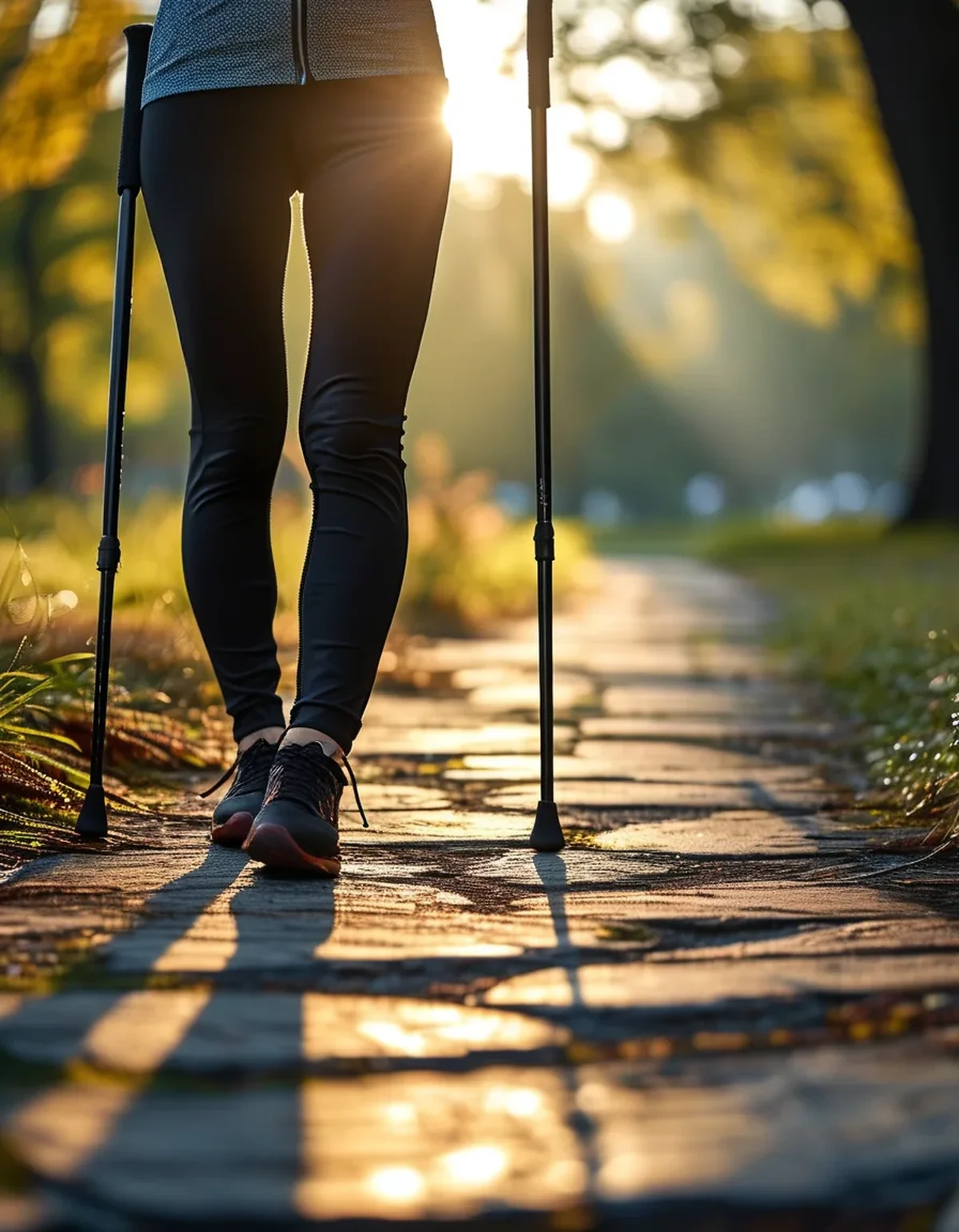
Seen here: High Waist Embossed Yoga Leggings with Side Pockets — shop it on bubblelime.com
Keep Reading
This article is for general informational and styling purposes only. Fit, sizing, and product availability may vary.