How Nordic Walking Pole Length Changes on Hills (And Why Most People Never Adjust It)
Quick Answer: Shortening your poles by roughly 5-10cm going uphill and lengthening them the same amount going downhill keeps your arm angle efficient — most Nordic walkers set one length for the whole route and lose power on hills as a result.
You set your poles to the perfect length before heading out, and it feels great on flat ground. Then you hit a hill, and suddenly the poles feel awkward — too short going up, oddly unstable going down. That’s not a sign to abandon poles on hills. It’s a sign they need adjusting.
Why does a single pole length stop working on hills?
Pole length is set for a specific arm angle relative to flat ground. On an incline, that same fixed length puts your arm in a mechanically weaker position — too acute an angle going uphill, too extended going downhill — which is why hills feel disproportionately harder with poles set for flat terrain.
How much should you actually adjust for an incline?
A rough guide is 5-10cm shorter for sustained uphill sections and 5-10cm longer for sustained downhill sections, with the exact amount depending on the steepness and your own arm length. Fixed-length poles obviously can’t do this, which is one real advantage of adjustable poles for varied-terrain routes.

What if you’re using fixed-length poles on hilly terrain?
You can partially compensate with technique — choking up on the pole grip (holding lower down the shaft) going uphill, and holding closer to the top going downhill — though it’s a smaller adjustment than a true length change and won’t fully replicate the effect.
Does the terrain type change this further?
Yes — a short, steep hill often isn’t worth stopping to adjust pole length for, while a sustained half-mile climb usually is. For short rolling terrain, technique compensation (the grip adjustment above) is more practical than repeatedly changing pole length.
What’s a sign your pole length is actively working against you on a hill?
If your shoulder feels like it’s straining to reach a plant point, or the pole tip is landing noticeably behind or ahead of where it should for a clean push-off, that’s usually the length-to-terrain mismatch showing up, not a fitness or technique failure.
TL;DR:
- A single flat-ground pole length becomes mechanically inefficient on hills
- Shorten poles 5-10cm uphill, lengthen 5-10cm downhill, terrain-dependent
- Fixed-length poles can partially compensate with a grip-choke technique
- Shoulder strain or awkward pole plants on a hill often signal a length mismatch, not fitness
If Nordic walking hills has always felt clumsier than flat routes, the poles — not your technique — are very likely still set for the wrong terrain.
See It in Motion
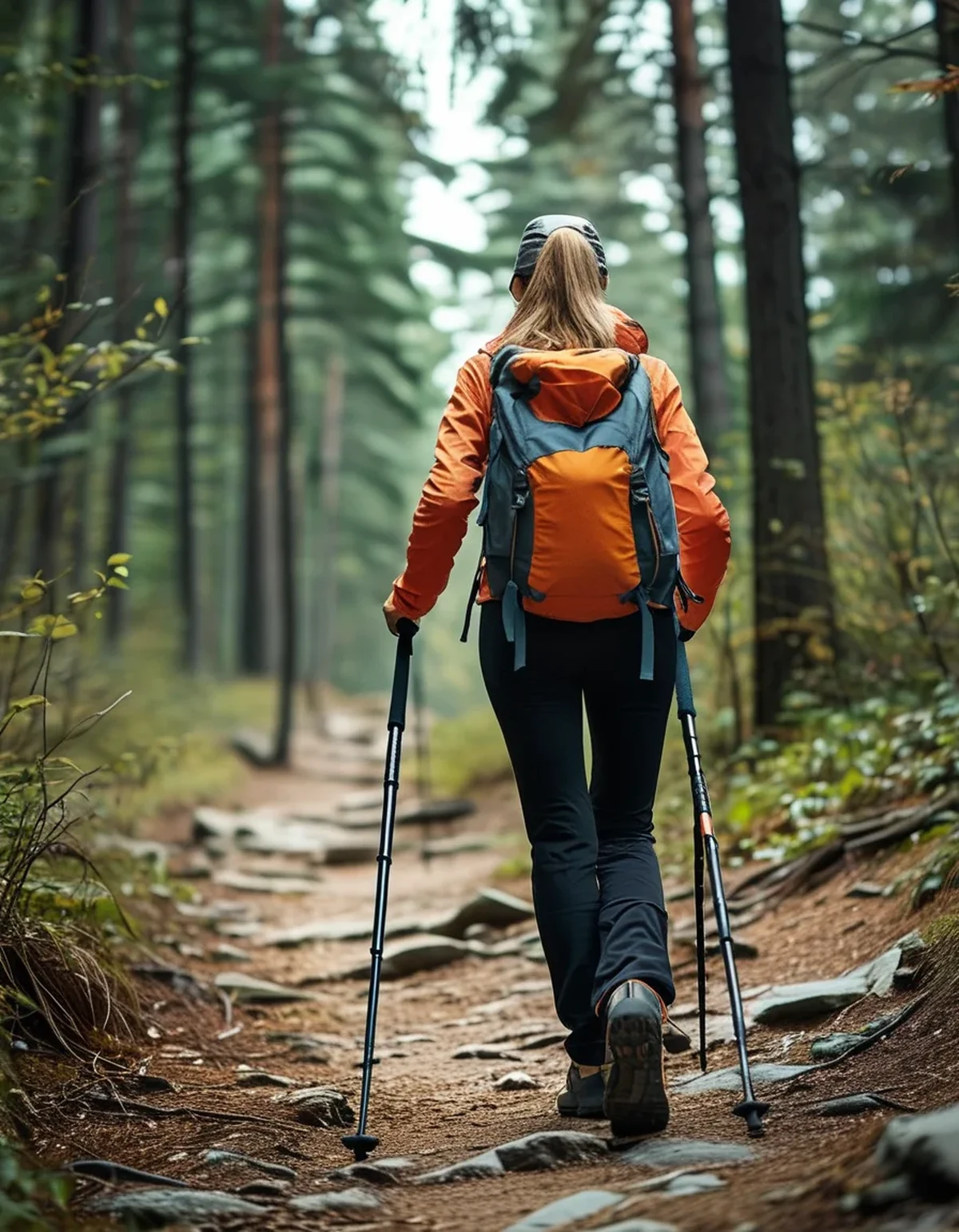
Seen here: High Waist Jogger Sweatpants with Pockets — shop it on bubblelime.com
Keep Reading
This article is for general informational and styling purposes only. Fit, sizing, and product availability may vary.