Does Nordic Walking Technique Actually Change on Pavement vs. Trail?
Quick Answer: Pavement offers more consistent pole grip but transmits more impact through the poles and joints, while trail surfaces are softer on impact but require more adaptive pole placement for uneven or loose ground. Neither surface requires a fundamentally different technique, but both call for small adjustments.
The push-off motion stays the same, but pavement and trail Nordic walking aren’t quite the same experience — and knowing the difference helps you get more out of either one.

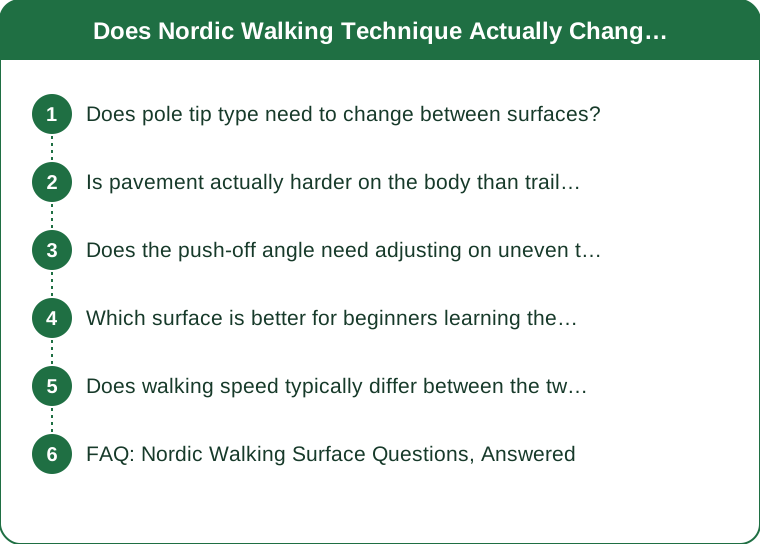
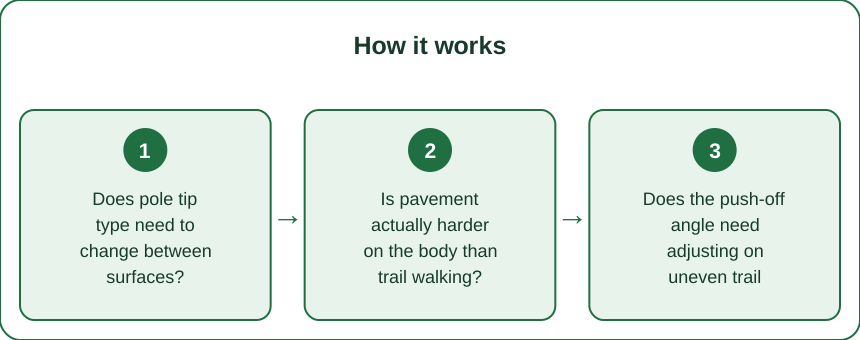
Does pole tip type need to change between surfaces?
Often yes — rubber pole tips grip pavement and hard surfaces more reliably, while metal or carbide tips bite into dirt, grass, or looser trail surfaces more effectively. Many Nordic walking poles come with interchangeable tips specifically for this reason.
Is pavement actually harder on the body than trail walking?
Yes, generally — pavement transmits more impact through the poles into the wrists, elbows, and shoulders due to its rigidity, compared to trail surfaces which absorb some of that shock naturally, meaning pavement walkers may want to pay closer attention to pole angle and grip tension.
Does the push-off angle need adjusting on uneven trail terrain?
Somewhat — on uneven or loose trail surfaces, a slightly more vertical pole plant provides more stability against unpredictable footing, while the more aggressive backward angle used on flat pavement can be maintained more consistently there.

Which surface is better for beginners learning the technique?
Pavement or a flat, groomed path is generally easier for beginners specifically because the consistent surface lets you focus purely on arm and pole mechanics without also managing uneven footing at the same time.
Does walking speed typically differ between the two surfaces?
Yes — most people naturally walk faster and more rhythmically on pavement, where the surface is predictable, while trail walking tends to be slower and more variable due to elevation changes and surface irregularity, which is a normal and expected difference.
FAQ: Nordic Walking Surface Questions, Answered
Do I need two sets of poles for pavement and trail walking?
Not necessarily — interchangeable tip caps on a single set of poles cover both surfaces without needing separate equipment.
Is trail Nordic walking more effective for fitness than pavement walking?
Both offer real benefit; trail walking often adds more variability in intensity due to terrain changes, while pavement offers more consistent, predictable effort levels.
Should beginners start on trail or pavement?
Pavement or a flat groomed path is generally the easier starting point for learning correct pole technique before adding uneven terrain into the mix.
TL;DR:
- Pavement offers consistent grip but transmits more impact through the poles and joints
- Trail surfaces absorb more shock but require more adaptive pole placement
- Rubber tips suit pavement; metal or carbide tips suit dirt and grass
- Beginners generally find it easier to learn technique on flat, predictable pavement first
If your wrists feel more fatigued after pavement walks than trail walks, check your pole tips and grip tension — that’s usually the surface difference talking, not your technique.
See It in Motion
Seen here: High Waist Yoga Leggings with Inner Pocket — shop it on bubblelime.com
Keep Reading
This article is for general informational and styling purposes only. Fit, sizing, and product availability may vary.