Nordic Walking Raises Your Heart Rate Without Feeling Harder, and That Is the Point
Quick Answer: Adding poles engages the upper body and trunk, raising oxygen consumption by roughly 15-20 percent and heart rate by 5-15 beats per minute at the same walking speed. Perceived exertion typically rises much less, because the load is distributed across more muscle rather than concentrated in the legs.
You tried poles expecting them to make walking easier. Your watch says the opposite happened, and your legs disagree with your watch. Both are right.

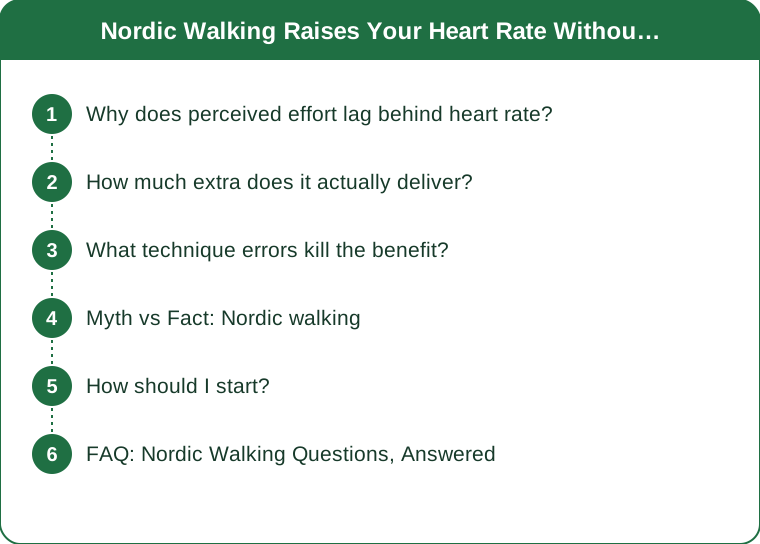
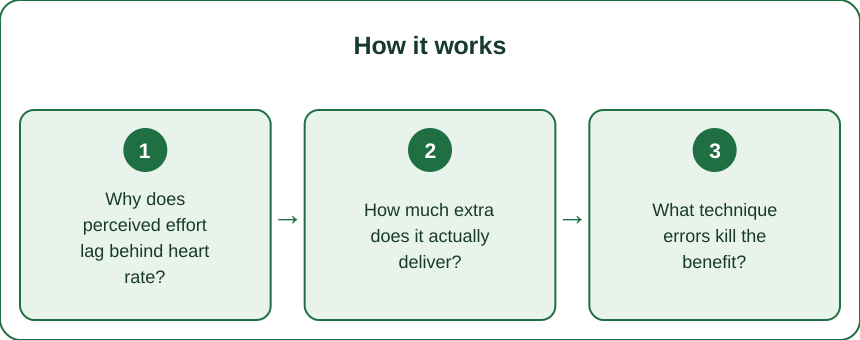
Why does perceived effort lag behind heart rate?
Perceived exertion is driven substantially by local muscular fatigue, the burn in a specific muscle group, rather than by whole-body oxygen cost.
Poles spread the work across lats, triceps, and trunk in addition to legs. No single muscle group accumulates fatigue as fast, so the walk feels the same or easier locally.
Meanwhile total muscle mass under load went up, which raises cardiac demand. That is the gap between what your legs report and what your watch records, and it is the entire appeal of the technique.
How much extra does it actually deliver?
The research on nordic walking is unusually consistent. At matched walking speeds versus ordinary walking:
- Oxygen consumption: up roughly 15-20 percent
- Heart rate: up roughly 5-15 bpm
- Caloric cost: up roughly 18-22 percent
- Perceived exertion: often statistically unchanged
That combination is rare. Most ways of making exercise harder also make it feel harder, which is why adherence suffers. This one does not, which is why it holds up over years.
What technique errors kill the benefit?
Three, and they are common.
Carrying the poles instead of pushing. If the poles are planted vertically and used for balance, upper-body engagement is near zero. The pole should plant behind the lead foot at an angle and get pushed against.
Gripping too tightly. The hand should open at the end of the push, letting the strap carry the load. A clenched grip fatigues the forearm and shortens the push.
Short arm swing. The arm should travel from roughly hip height in front to fully extended behind. Half-swings deliver a fraction of the benefit.

Myth vs Fact: Nordic walking
Myth: Poles are for people with balance problems. Fact: balance support is a legitimate use, and it is a completely different technique than the athletic version, which is a propulsion tool.
Myth: Any trekking pole works. Fact: nordic poles use an angled strap or glove system that lets you push with an open hand. Trekking poles with simple loops force a gripped push, which is much less efficient.
Myth: It is only for flat ground. Fact: the benefit is largest on flats and gentle grades, but poles also reduce knee loading on descents by a meaningful margin.
Myth: It replaces strength training. Fact: it is aerobic work with upper-body involvement, not resistance training. Loads are far too light to drive strength adaptation.
How should I start?
Short and technique-first, because bad technique locks in fast.
- Two sessions of 20 minutes focusing only on plant angle and arm swing, on flat ground
- Pole length at roughly 68 percent of your height, which puts the elbow near 90 degrees when planted
- Build to 40-45 minutes over three to four weeks
- Check heart rate against a poleless walk on the same route to confirm the technique is working
That last check is the useful one. If your heart rate is not measurably higher than an ordinary walk at the same pace, the poles are being carried rather than used.
This is general information, not medical advice. Shoulder or elbow pain that persists warrants a professional look before adding volume.
FAQ: Nordic Walking Questions, Answered
Is it hard on the shoulders?
Not with correct technique, since the push comes from the lat and triceps with a relaxed grip. Shoulder complaints almost always trace back to gripping and over-reaching.
Can I do it on a treadmill?
Awkwardly. The pole plant needs ground that moves with you, so it does not translate well. Outdoor or a track is far better.
How does it compare to running for joint load?
Substantially lower impact, with poles absorbing a portion of ground reaction force. It is a common bridge for people who cannot tolerate running volume.
TL;DR:
- Poles raise oxygen cost 15-20 percent while perceived effort barely moves
- The benefit only appears if you push against an angled pole plant, not carry a vertical one
- Open the hand at the end of the push and let the strap do the work
- Pole length around 68 percent of your height, verified by heart rate against a poleless walk
Do one walk with poles and one without on the same route this week and compare average heart rate. If the difference is under five beats, your technique needs the plant angle fix, and that is a much more useful finding than any amount of reading.
See It in Motion
Seen here: High Waist Yoga Leggings with Inner Pocket — shop it on bubblelime.com
Keep Reading
This article is for general informational and styling purposes only. Fit, sizing, and product availability may vary.